
takepayments Release UK Dining Trends Report, Revealing the Habits Shaping the UK Restaurant Scene
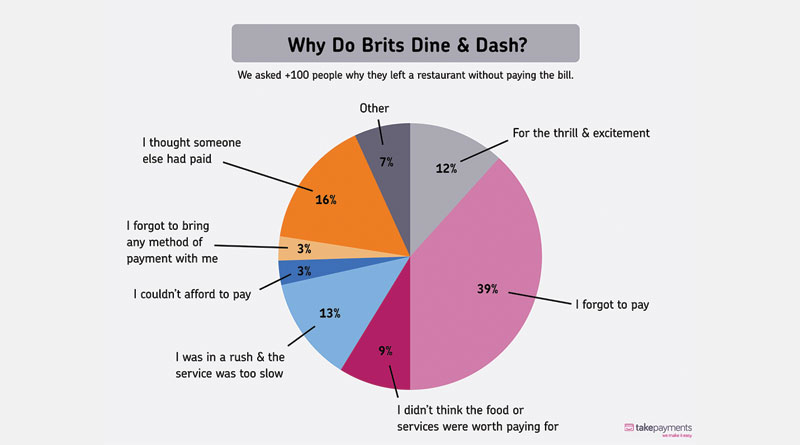
• 8% of diners in the study admitted to leaving a restaurant without paying for their meal
• 21% of diners are so put off when asked to pay a deposit for a table that they’d prefer to book elsewhere
• 1 in 8 UK diners have failed to turn up for a restaurant booking
• New research from takepayments has revealed that 8% of Brits have admitted to leaving a restaurant without paying for their meal.
The UK’s leading card payment solutions provider surveyed 1,500 UK adults to investigate what restaurant visitors expect from their dining experience.
The research reveals that two-thirds of diners (66%) are deterred from booking when a restaurant asks for a deposit, with 21% going so far as to say they’d book elsewhere, whilst 44% said they’d still book even if they were discouraged.
One in eight diners said they’ve been a ‘no show’ for a restaurant booking, with nearly two-thirds (60%) saying they simply forgot to cancel. Another 1 in 6 (15%) said they were too embarrassed to contact the restaurant, and the same amount stated that it was ‘too much effort’ to get in touch.
Even in fast-food environments, diners still crave personal interaction.
When it comes to ordering and paying, dealing directly with a member of staff was the most popular option for both sit-down and fast food restaurants.
50% prefer to order with a staff member in sit-down restaurants, while this preference reduces to 38% for quick-service establishments. The most significant contrast was ordering through a self-service kiosk.
Whilst 37% chose this option for QSRs, only 6% chose it for sit-down restaurants. Interestingly, only 15% prefer to order using a QR code for both types of restaurants.
59% of diners want to pay a staff member directly at a sit-down restaurant. Paying using a kiosk (34%) follows closely behind paying staff (38%) in fast food restaurants. Paying through a QR code was the least popular option for both types of restaurants.
One in six diners (17%) said they never tip restaurant staff. A third said they always tip to support staff, whilst 37% said they tip depending on the level of service. 73% of the respondents said they want more clarity over whether tips are fairly distributed throughout the staff.
When it comes to service charges, over a third (37%) strongly believe that a service charge shouldn’t be added automatically to their bill, and nearly 1 in 10 actively avoid a restaurant after this practice (9%).
43% of diners review the amount of service charge a restaurant imposes before deciding whether to eat there, and 24% avoid establishments where the charge isn’t clear.
What can restaurants take away from the findings?
Darren Larkman, Field Sales Director at takepayments (now a Global Payments company):
Streamline booking systems to reduce ‘no-shows’ – “That could be an easy-to-use online system, clear instructions for walk-ins, or flexible deposits. Automated reminders and easy cancellation links help diners cancel responsibly, freeing up tables and protecting revenue. It’s about making things easier for customers while keeping businesses running smoothly.”
Offer multiple options for ordering & paying to provide a great customer experience across generations – “Our research shows ordering and payment preferences vary by age, particularly in fast food.
Younger diners (18–24) are more likely to use self-service kiosks (49%) and QR codes (24%), whereas those over 55 prefer to speak with staff (52%). Offering a mix of options is just the start — each should be seamless and secure, with staff trained to assist those less confident with technology. This keeps queues moving, improves the experience, and builds trust to encourage return visits.”
Make use of self-service kiosks, but don’t forget the human touch – “Even in fast food restaurants, many still like paying a staff member — the human touch matters. But kiosks are catching up fast; they speed things up, give customers more control, and support staff during busy periods. The key is making kiosks easy to use, well-signed, and well-maintained while still having staff available for face-to-face support. That way, every customer gets the experience they want, and businesses avoid losing sales.”
Provide transparency around tipping & service charges – “Transparency builds trust, reduces complaints, and encourages repeat visits. Clearly explain how tips are distributed – display information on menus or at tables so diners know their money supports staff fairly. Make service charges optional where possible to avoid deterring customers. Train staff to explain tipping policies and offer varied payment options — cash, card, QR codes, and mobile, so everyone can tip in the way that suits them.”
Take steps to avoid customers ‘dining and dashing’ – “Have a clear payment process so every table knows how and when to pay – at the table, the till, or via kiosk. Table ordering systems reduce accidental non-payment while keeping things smooth. Assign sections to staff and train them to handle issues in a calm and professional manner.
Consider pre-payment or deposits for large groups, and use CCTV visibly as a deterrent and for evidence when needed. If CCTV is used, inform customers to maintain transparency.”